
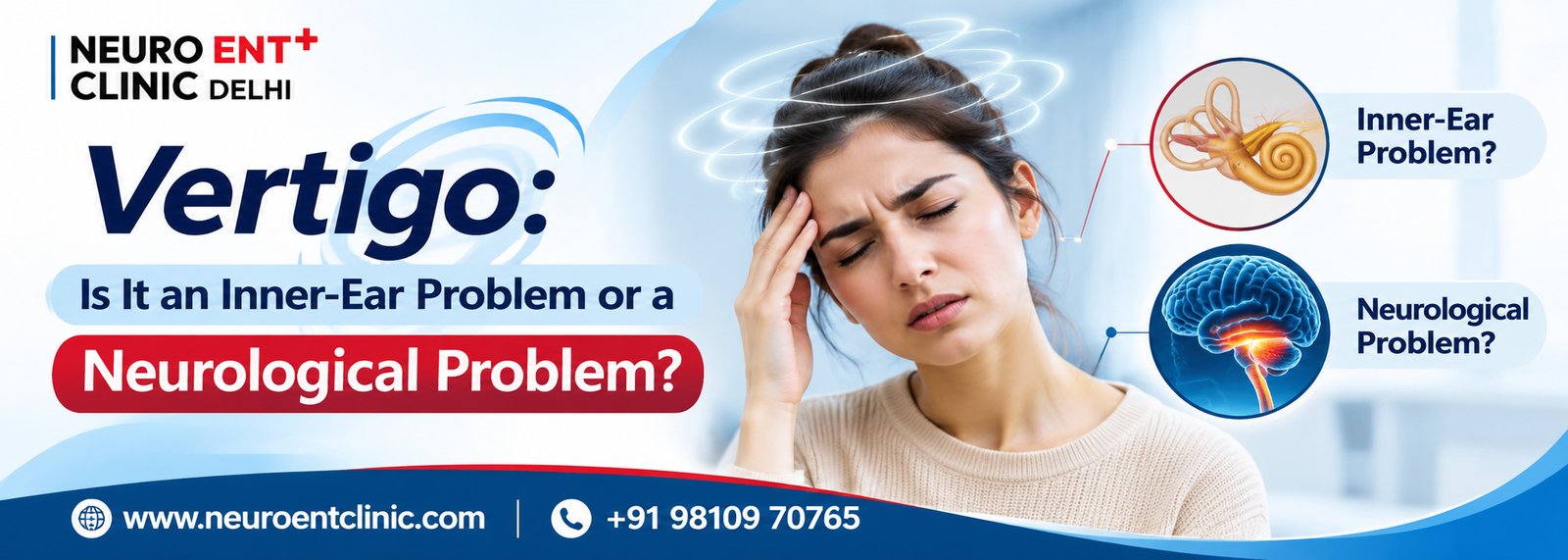
Have you ever experienced a sudden sensation that the room is spinning, even when you are sitting or standing still? Do you feel unsteady while walking, or experience dizziness when turning your head? These symptoms may indicate vertigo, a condition that affects your sense of balance and spatial orientation.
Vertigo is not a disease itself but a symptom that can arise from problems in the inner ear or the brain and nervous system. Understanding its underlying cause is important for choosing the right treatment.
Vertigo is the false sensation that you or your surroundings are moving or spinning. It may last a few seconds, several minutes, or even hours, depending on its cause.
Common symptoms include:
A spinning or tilting sensation.
Loss of balance or unsteadiness.
Nausea and vomiting.
Difficulty walking or standing.
Abnormal eye movements.
Sweating and discomfort during episodes.
The inner ear plays an important role in maintaining balance. It contains specialised structures that send information about head movement and body position to the brain.
When these structures are affected, the brain may receive incorrect balance signals, resulting in vertigo.
Some common inner-ear conditions include:
Benign Paroxysmal Positional Vertigo (BPPV): One of the most common causes of vertigo. It occurs when tiny calcium crystals move into the wrong part of the inner ear. It can trigger brief spinning sensations when changing head positions, such as turning in bed or looking upwards.
Vestibular Neuritis: Inflammation affecting the vestibular nerve can cause sudden, intense vertigo, often accompanied by nausea and difficulty maintaining balance.
Ménière’s Disease: This inner-ear disorder may cause recurring vertigo episodes, fluctuating hearing loss, tinnitus (ringing in the ears) and a feeling of fullness in the affected ear.
An ENT specialist can assess these conditions through clinical examination and appropriate balance or hearing tests.
Sometimes, vertigo originates from the brain or central nervous system rather than the inner ear. This is known as central vertigo.
Possible neurological causes include:
Vestibular Migraine: People with vestibular migraine may experience repeated episodes of dizziness or vertigo, sometimes with headache, light sensitivity or sound sensitivity. Headache may not always be present.
Stroke: A stroke affecting areas of the brain responsible for balance and coordination can cause sudden vertigo. It may also be associated with difficulty walking, double vision, weakness, numbness or speech problems.
Other Neurological Conditions: Certain disorders affecting the brainstem, cerebellum or nervous system can interfere with balance and coordination.
Neurological causes require careful evaluation, particularly when symptoms appear suddenly or are accompanied by other neurological signs.
Identifying the cause of vertigo requires a detailed medical history and clinical examination. Depending on the symptoms, investigations may include:
Positional tests to identify BPPV.
Hearing and vestibular function tests.
Neurological examination.
MRI or CT imaging when clinically indicated.
An ENT specialist or neurologist may be involved depending on the suspected cause.
Treatment depends on the underlying condition. BPPV may improve with specialised repositioning manoeuvres such as the Epley manoeuvre. Other inner-ear conditions may require medication, vestibular rehabilitation or condition-specific treatment.
Neurological causes require treatment directed at the underlying problem. For example, vestibular migraine may need migraine management, while a suspected stroke requires immediate emergency assessment.
Important: Sudden vertigo accompanied by facial weakness, arm or leg weakness, difficulty speaking, double vision, severe imbalance or a sudden severe headache requires emergency medical attention. Do not assume it is an inner-ear problem.
Vertigo can affect your daily activities, confidence and quality of life. The key to effective management is identifying whether the problem originates in the inner ear or the nervous system.
At NeuroENT+ Clinic Delhi, patients can seek specialist evaluation for ENT and neurological concerns.
Consult our specialists:
Dr. Deepti Chaudhary – Senior Consultant, Otorrhinolaryngologist (ENT Specialist).
Dr. P. K. Chaudhary – Neuro Surgeon & Senior Consultant.
🌐 Website: www.neuroentclinic.com
📞 Appointment: +91 98109 70765
Do not ignore recurring dizziness or spinning sensations. Seek timely medical evaluation to understand the cause and receive appropriate care.
Welcome NeuroENT


